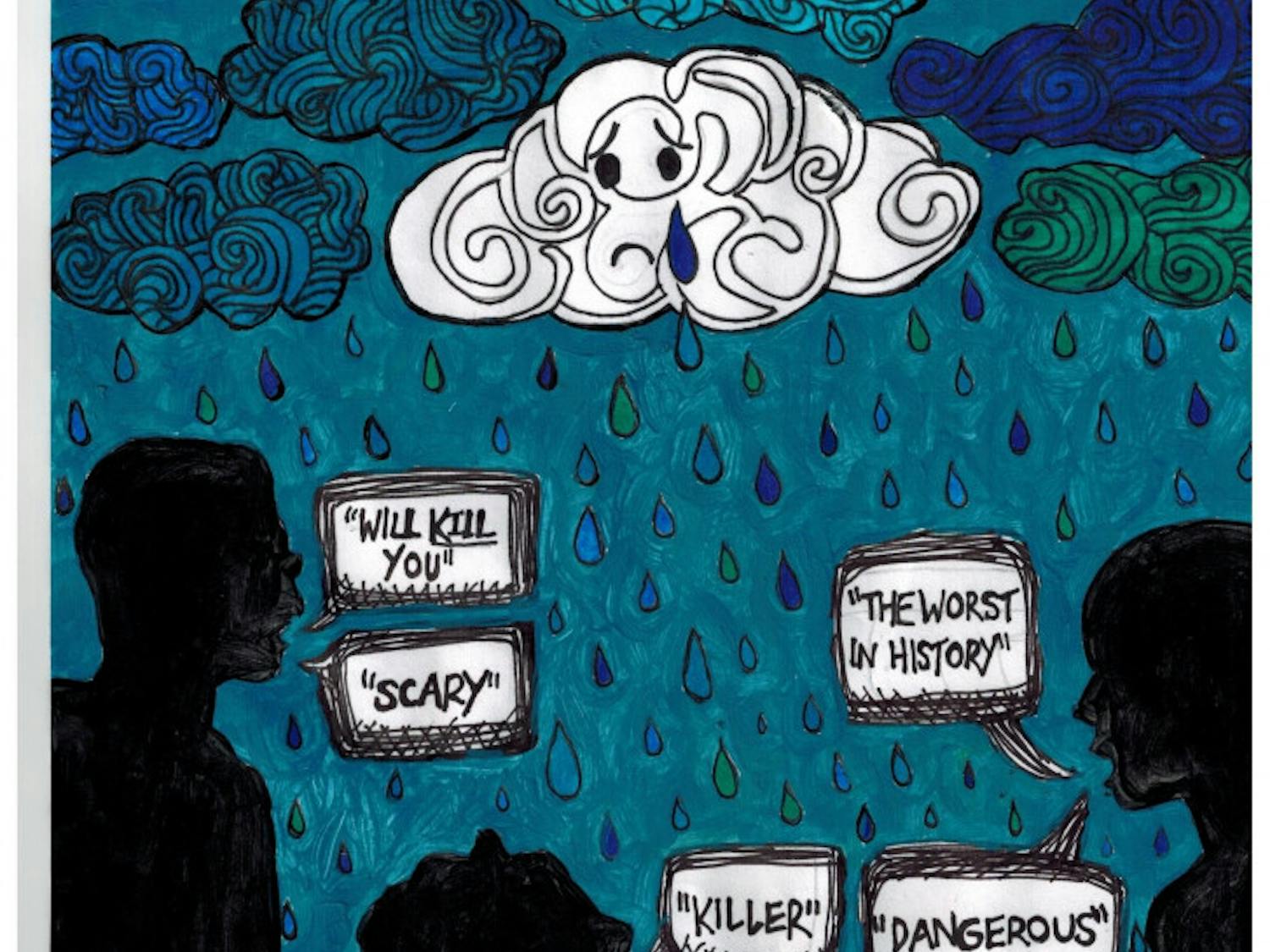


An attempt to prove fake news failed, but are we surprised?
Nov. 28, 2017A failed attempt by Project Veritas to expose the Washington Post for media bias has the U.S. once again cooing about fake news and the dishonest and corrupt media.
A failed attempt by Project Veritas to expose the Washington Post for media bias has the U.S. once again cooing about fake news and the dishonest and corrupt media.
For the next two weeks the majority of us will be bogged down by endless assignments, finals and lengthy papers. While it’s easy to lose your motivation and throw up your hands, I hope you have the strength to finish strong.
A guy friend of mine recently crashed a girls’ night out. It was a Thursday like any other: unnecessary wedges, ‘90s song requests and all we could drink. It even ended where all GNO’s should — at the Flaco’s Cuban Bakery window. Just one thing kept me from calling the night a success, however. That night, I learned one important thing. Nothing spoils an arepa more than these words from our token dude: “I didn’t know girls talk about guys so much.”
Throughout life we are encouraged to have a “Plan B.” Didn’t get into UF? Clown school it is. Leonardo’s By the Slice is closed? Italian Gator it is. We miss the pill, or the condom breaks? Then we seek out the Morning After Pill (MAP) as soon as possible.
A couple of days ago, a video of Malia Obama blowing smoke rings went viral. The internet flipped out. Everyone either sang her praises or was deeply offended. “Go, Malia! I’m glad you’re having fun in college and doing your own thing! Get it, girl!” Or, “How dare she! What a delinquent. As a daughter of a former president, she should not be behaving in this manner.” There was a third response, which was something along the lines of, “Who cares?” This whole incident brought to mind something I find very important. It is also something frequently underemphasized, particularly in this day and age. This, dear reader, is the art of minding your own business.
Roy Moore. Al Franken. John Conyers. Bill Clinton. Harvey Weinstein. Bill O’Reilly. The list goes on. The past year has brought an onslaught of sexual harassment and assault allegations from Hollywood and Washington, D.C. It’s sad and telling that this is at least the second time this semester I’ve written about this topic, but it’s not going away anytime soon.
In this political climate, it can be tempting to surround yourself with like-minded folks and call it a day — online and offline. On our social media, it would be easy (and, let’s face it, understandable) to unfollow every user who posted a status update or wrote a tweet decrying a politician you admire or denouncing a policy you believe would help people. You could even replace the lost profiles with more accounts of people who agree with and amplify your views. But is this the right thing to do?
The other day, a friend of the Alligator opinions editor asked her why she wants to fight injustice. Being honest, Abby said herself she didn’t know how to answer the question with anything other than the elementary and unimpressive response: “because it’s wrong.” Now to use one of those activist buzzwords, we at the Alligator are going to “unpack” this question.
As I’m sure you're aware, Thursday is Thanksgiving. As I’ve wished friends and classmates a happy holiday, I’ve gotten mixed reactions. Some wish me the same. Some gush about family traditions and Thanksgiving foods. Some talk about seeing their families for the first time in four months. Some talk about partying with high school friends. Some, however, scoff at the well wishes. They say they hate Thanksgiving because it celebrates colonialism and the abuse of Native Americans. They hate it because they can’t stand their families (or their families’ political beliefs). They hate it because they don’t like the food or are the only vegan or vegetarian at the table. Or, they hate it because they find it hard to give thanks in that environment.
“I’m low-key scared he’s going to sexually assault me.”
In 2004, after serving as a college dean for two years, I asked my director of human resources for input on my performance.
You are woken up by the sound of your parents and grandparents chatting loudly and energetically over coffee at the kitchen table and the smell of pies being prepped for baking. You’re still tired, but you get out of bed anyway so you don’t miss any of the family fun.
When I first read Tom Stoppard’s play, “Rosencrantz and Guildenstern are Dead,” I was in what I like to dub the first great existential crisis of my life. It was my senior year of high school and the only thing that gave me any sense of purpose in my life was focusing on college applications. Getting into college — my top choice, specifically — was the only goal I had. After that, I wasn’t sure what I wanted to study or what I wanted to do. I was beginning to realize the be-all and end-all of my high school life was not the be-all and end-all of life.
The saying “Jack of all trades, master of none” might apply to most areas of life, but I don’t believe art is one of them. Out of all the types of skills to have, artistic competency has to be one of the most malleable because of its inclusion of more than simply technical ability. Making broad generalizations about anything creatively done is something worth straying away from, but I think there is something to be said about what makes truly great art.
I’m prone to losing. Just this week, I walked right into a table in Midtown, which left me with a fist-sized bruise on my hip and a drink spilled all over me. I also accidentally texted a screenshot of a conversation to the person I was having that conversation with. I started uncontrollably crying at a Bon Iver concert and, like all of you, watched the Gators lose.
I don’t think the only problem with Richard Spencer is that he is a white supremacist. The problem with Spencer is that he provides a bogus answer to a legitimate and enigmatic question academia has left unexplored: What does it mean to be white in 21st century America?
Up until recently, I thought most classes in college weren’t composed of multiple choice tests. I figured college was a place you got your hands dirty and learned how to deal with real-life material, as you would in your professional field. While my major (journalism) and some others actually do this, I feel most of the majors offered at UF are lacking when it comes to providing students with real world experiences. It’s time we start talking about this.
It’s about that time during Fall semester when we all start to lose our minds. The reality of final exams and the end of the semester is looming over us, and the fate of our final grades hangs in the balance of how the next few weeks goes. Needless to say, every student within the general vicinity of UF right now is stressed beyond belief.
You may have heard of the term gaslighting. It can happen between supposed friends, between an employee and their superior or in any other relationship. Whether within our own student organizations or on a national scale, it happens every day.
Last Wednesday, I was at my usual weekly Undergraduate Philosophy Society meeting (shameless plug, check us out on Facebook). That evening, the discussion centered around how we should attempt to understand bullying and how to prevent kids from doing it. Quickly, the group of us recognized the ways in which bullying mirrors — and frequently reflects — different phobias and other bad “-isms” like homophobia, racism, sexism and transphobia.