

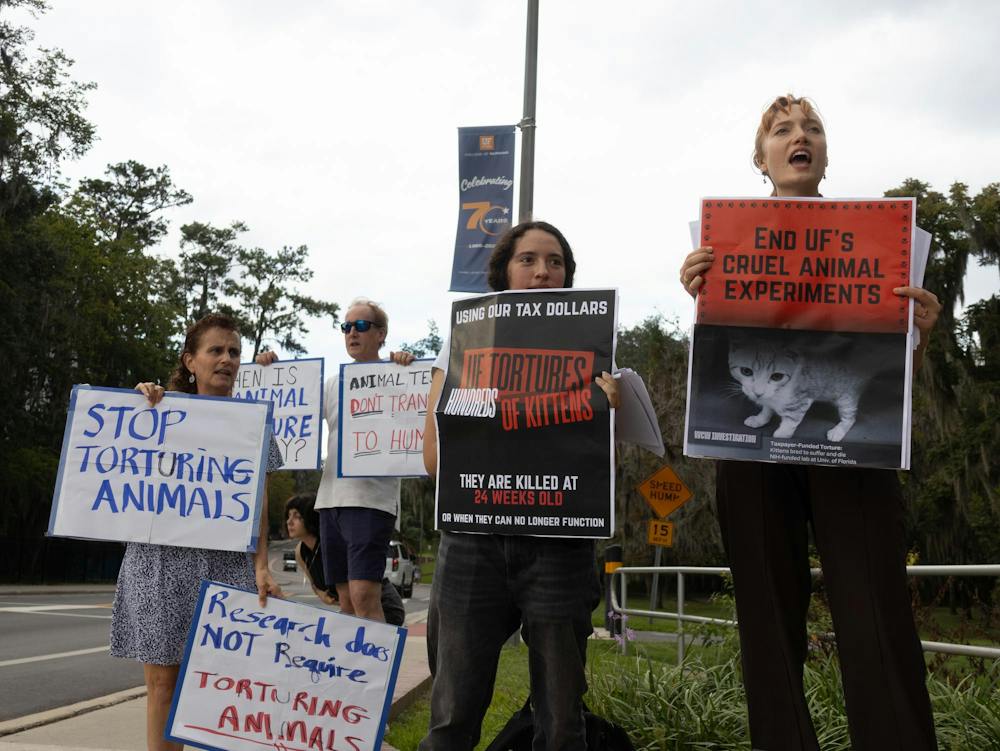
Animal rights activists called on UF to end the cat gene therapy injection experimentation, which is funded by a nearly $2.7 million federal grant.
Dr. Charles Vite is the project’s lead researcher. The work is funded by a National Institutes of Health grant totaling almost $2.7 million. It runs from Dec. 15, 2023 to Nov. 30, 2026 according to NIH records.
Protesters gathered outside of UF’s Communicore Building, home to the labs hosting the animal experimentations, and chanted that the university has “buckets of blood” on its hands.
The research involves 119 cats and studies gene therapy for Niemann-Pick disease type C1, a rare genetic condition that creates a buildup of fat within cells, restricting mobility and causing other neurological impairments, according to NIH grant reports.
The White Coat Waste Project, a federal nonprofit watchdog group, obtained video footage from inside the facility this June through public records requests.
The protest references the experiment in which 6-week-old kittens with artificial Niemann-Pick are given a gene therapy injection on their neck, according to the NIH records. Without treatment, cats are expected to live an average of about six months, when they’re then euthanized.
“No animals die of their disease and all are euthanized when the clinical endpoints are reached,” record’s obtained by WCW said.
Of the 119, 5 cats are treated and observed up to 3-years-old “or until neurological signs necessitate euthanasia,” according to the record.
In an email statement to The Alligator, UF Research spokesperson Joseph Kays wrote the university “recognizes that research involving animals raises important and deeply felt concerns.” All animal research at UF “undergoes rigorous, federally mandated review,” the department added.
Before any studies begin, UF research proposals are reviewed by the Division of Sponsored Programs, which ensures “efficient and effective proposal management practices” by setting institutional policies and running systems used to review the proposals, according to its website.
UF’s Institutional Animal Care and Use Committee is responsible for approving all research using live vertebrate animals, inspecting animal facilities and investigating concerns surrounding animal welfare.
The site states that no work on animals can begin until the application is approved.
UF Research emphasized in its statement its commitment to ethical practices and prioritization of animal health.
Vite and the Institutional Animal Care and Use Committee did not respond to two requests for comment by phone in time for publication.
Anthony Belotti, the president and founder of White Coats Waste, leads the organization that investigated the UF experiment and said the organization tracks federal spending on cat experiments.
Belotti, a former staffer working in an animal testing lab, founded the organization in 2011 to track federal spending on laboratories and hold government officials accountable.
Kailey Mauro, the group’s research and investigations manager, said Vite was already on the group’s radar for his involvement in another study from 2021 through 2023 involving cats at the University of Pennsylvania.
Mauro said it has identified a second project at UF dating back to 2020, receiving more than $837,000 from the NIH, that involves cough and reflex testing on cats, another example of federally funded research at UF.
Belotti points out a gap between Health Secretary Robert F. Kennnedy Jr.’s Health and Human Services’ promise to end animal testing and the administration’s actual spending.
“Rhetoric does not match the receipts,” Belotti said.
He said agencies like the U.S. Navy, Department of Agriculture, Environmental Protection Agency and Department of Veteran Affairs have begun phasing out animal testing, and added that the NIH is the “black sheep” of the administration.
The People for the Ethical Treatment of Animals organization estimates about 12,000 cats remain in U.S. labs.
Gainesville Animal Defenders, a local grassroots group committed to ending animal cruelty, said it protested Friday to educate the campus community about what happens in labs. The group handed out flyers detailing the research.
Cheyenne Lukander, a 25-year-old UF urban and region planning master’s student who organized the protest, said UF is one of the largest animal testers in Florida.
USDA’s 2025 annual report confirmed that UF conducts research on 3,940 animals, 455 of which are cats.
Friday’s protest took place on The Anti-Vivesection Alliance’s fourth annual world protest day. The alliance advocates for an end to animal experimentation.
Around 15 other animal activists joined Lukander for the demonstration.
Lynn Max, a 58-year-old member of Gainesville Animal Defenders, called UF’s lab work “despicable” and said its research can be done with artificial intelligence.
Max has been involved with the organization for two years, but her activism spans further. She was among the demonstrators who demanded beagles to be released from Ridglan Farms, a commercial breeder for animal experimentation in Wisconsin.
Max said she went to Wisconsin and protested while police fired rubber bullets at the crowd in April. She believes the protest helped free the facility’s roughly 1,500 beagles.
“They’ll just keep doing it if people don’t bite and people don’t say, ‘We don’t want this; we don’t need this,’” Max said.
Contact Juleidi Machuca at jmachuca@alligator.org.

Juleidi is a history and journalism junior at UF and serving as one of the Fall 2026 Photographers. This is her fourth semester on staff and her favorite assignment to cover is protests. In her spare time, she can be found journaling or TikTok dancing.


